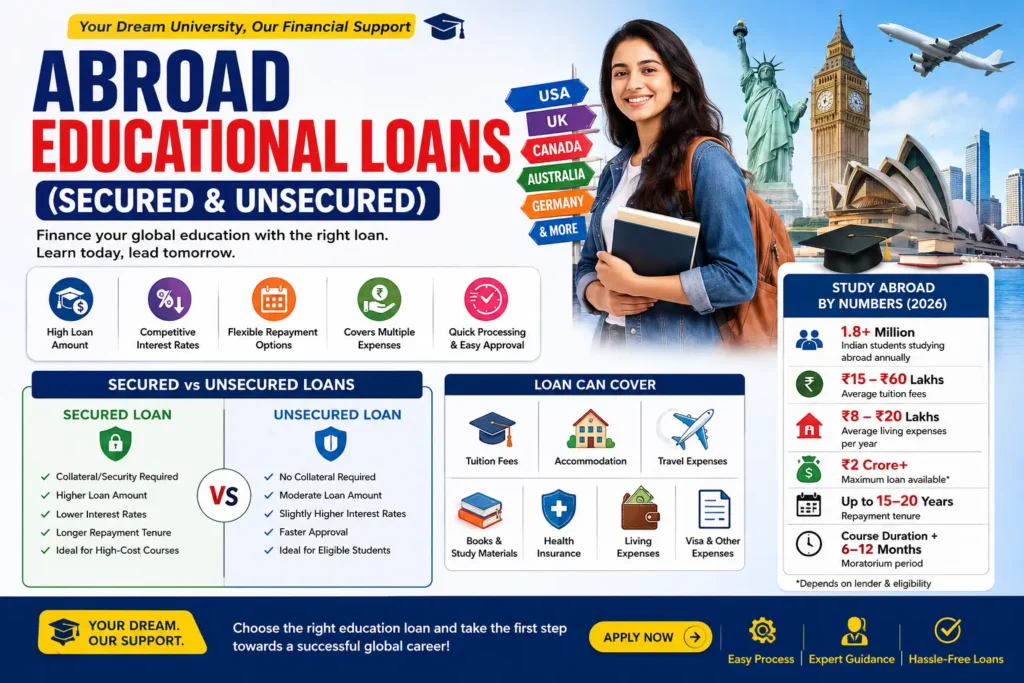
Abroad Educational Loans (Secured & Unsecured)
Abroad Educational Loans (Secured & Unsecured): Complete Guide for Students Planning to Study Abroad
Every year, thousands of Indian students dream of pursuing higher education in countries like the USA, Canada, the UK, Australia, Germany, Ireland, New Zealand, and many others. While these opportunities offer excellent academic and career prospects, they also involve significant expenses, including tuition fees, accommodation, travel, insurance, books, and living costs.
For many families, paying these costs upfront can be challenging. This is where abroad educational loans (secured & unsecured) become an essential financial solution. Whether you have property to pledge as collateral or prefer a loan without security, today’s banks and financial institutions offer a wide range of options to help students achieve their international education goals.
However, choosing the right education loan is not always straightforward. Students often have questions such as:
- Which loan option is better—secured or unsecured?
- How much loan amount can I get?
- What documents are required?
- Which banks offer the lowest interest rates?
- Can I get a loan without collateral?
- How long does the approval process take?
- Which expenses are covered under the loan?
This comprehensive guide answers these questions in detail. You’ll learn the differences between secured and unsecured education loans, understand eligibility criteria, compare financing options, and discover practical tips to improve your chances of approval. By the end, you’ll be equipped to choose the loan that best fits your academic ambitions and financial circumstances.
Quick Statistics (2026)
Study Abroad by Numbers
| Metric | Estimated Value |
|---|---|
| Indian students studying abroad annually | 1.8+ Million |
| Average tuition fees | ₹15 Lakhs – ₹60 Lakhs |
| Average living expenses | ₹8 Lakhs – ₹20 Lakhs/year |
| Maximum education loan available | ₹2 Crore+ (depends on lender) |
| Loan repayment tenure | Up to 15–20 Years |
| Moratorium period | Course duration + 6–12 months |
Note: These figures vary based on the country, university, course, lender, and the applicant’s financial profile.
Infographic
Abroad Educational Loan Journey
Choose University
        │
        ▼
Receive Admission Letter
        │
        ▼
Compare Secured &
Unsecured Loan Options
        │
        ▼
Select Bank / NBFC
        │
        ▼
Submit Documents
        │
        ▼
Loan Assessment
        │
        ▼
Loan Sanction
        │
        ▼
Visa Process
        │
        ▼
Tuition Fee Disbursement
        │
        ▼
Begin Your Study Abroad Journey
What Are Abroad Educational Loans?
An abroad educational loan is a specialized financing solution designed to help students fund higher education in international universities. These loans are offered by banks, Non-Banking Financial Companies (NBFCs), and other financial institutions to cover the cost of studying outside India.
Unlike personal loans, education loans are tailored to meet academic expenses and often include benefits such as a moratorium period, longer repayment tenures, and tax advantages under applicable regulations.
Depending on the lender and the student’s profile, an education loan may be:
- Secured – backed by collateral such as residential property, fixed deposits, or other approved assets.
- Unsecured – granted without collateral, based on factors such as the student’s academic performance, admission to a recognized university, the co-applicant’s income, and creditworthiness.
These loans can support students pursuing undergraduate, postgraduate, doctoral, diploma, or specialized professional programs abroad.
Why Do Students Choose Abroad Educational Loans?
Pursuing international education offers access to world-class institutions, global career opportunities, and advanced research facilities. However, the associated costs can be substantial.
An abroad educational loan helps bridge this financial gap by providing funds for:
- Tuition fees
- Accommodation and hostel expenses
- Books and study materials
- Laptop or educational equipment (as permitted by the lender)
- Travel expenses
- Visa-related costs
- Health insurance
- Examination and laboratory fees
- Living expenses during the course
- Other approved educational costs
This financial support enables students to focus on their studies while spreading repayment over a manageable period after completing their education.
Types of Abroad Educational Loans
When planning to study overseas, students generally have two primary financing options:
1. Secured Abroad Educational Loan
A secured education loan requires the borrower or co-applicant to provide collateral as security. Common forms of collateral include:
- Residential property
- Commercial property
- Fixed deposits
- Government securities
- Life insurance policies with surrender value (subject to lender norms)
Because the lender has security against the loan, secured loans often come with:
- Higher loan limits
- Competitive interest rates
- Longer repayment tenures
- Greater flexibility for expensive courses
This option is often suitable for students enrolling in high-cost programs such as medicine, engineering, management, or postgraduate degrees at internationally recognized institutions.
2. Unsecured Abroad Educational Loan
An unsecured education loan does not require collateral. Approval is generally based on factors such as:
- Admission to an approved university
- Academic performance
- Course and future employability
- Co-applicant’s income and financial stability
- Credit profile
These loans offer a faster application process and eliminate the need to pledge assets, making them a practical choice for eligible students who meet the lender’s underwriting criteria.
Secured vs Unsecured Abroad Educational Loans
| Feature | Secured Loan | Unsecured Loan |
|---|---|---|
| Collateral Required | Yes | No |
| Maximum Loan Amount | Higher | Moderate (varies by lender) |
| Interest Rate | Generally Lower | Generally Higher |
| Approval Time | Moderate | Often Faster |
| Risk to Assets | Yes | No |
| Repayment Tenure | Longer | May Be Shorter |
| Best For | High-cost international programs | Students without collateral and strong eligibility |
Which Option Is Better?
There is no universal answer. The right choice depends on your financial situation, course fees, available collateral, and repayment capacity.
A secured abroad educational loan may be more suitable if you require a larger loan amount at a competitive interest rate and have eligible collateral.
An unsecured abroad educational loan may be preferable if you do not wish to pledge assets and have a strong academic profile, admission to a reputable institution, and a financially stable co-applicant.
The next sections of this guide will explain eligibility, documentation, loan amounts, interest rates, and lender comparisons to help you make an informed decision.